Story at a Glance
- Two new Japanese studies paired blood samples from 23 dogs and 30 cats with the actual pet food they were eating, revealing clear species differences in PFAS exposure
- Cats showed much higher levels of long-chain PFAS like PFNA, PFDA, and PFUnDA, largely driven by fish-based ingredients that accumulate contamination from marine food webs
- Dogs carried different PFAS chemicals from more varied sources — drinking water, indoor dust, household products, and shared environmental exposures — not just their food bowl
- PFAS exposure has been linked to thyroid disruption, immune effects, and hyperthyroidism in cats — one of the fastest-growing chronic conditions veterinarians see in seniors
- Practical fixes include rotating proteins away from fish, filtering water for PFAS specifically, cutting indoor dust, using stainless bowls, and choosing brands that publish product testing
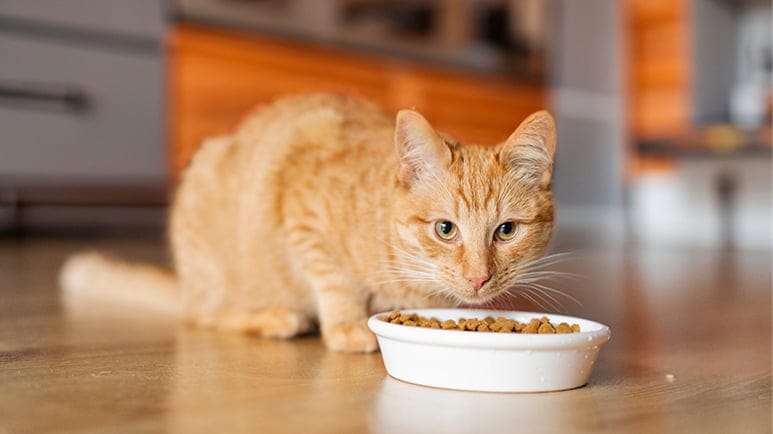
You read the ingredient label. You paid more for the good brand. You maybe even called the company to ask about sourcing. And still, according to a growing pile of research, there is a decent chance your dog or cat is being exposed to a class of persistent industrial chemicals every time they eat — chemicals that are not listed anywhere on the bag.
They are called PFAS. And a pair of new studies out of Japan is drawing an unusually direct line between what is in your pet's bowl and what is showing up in their blood, especially if you share your home with a cat.1
What PFAS Are and Why Anyone Is Worried
PFAS stands for per- and polyfluoroalkyl substances — a big family of synthetic, oil- and water-repellent chemicals that have been used for decades in nonstick cookware, waterproof coatings, stain-resistant fabrics, firefighting foams, food packaging, and industrial manufacturing. The problem is that once they are made, they do not really break down. Scientists call them "forever chemicals" for a reason.2
PFAS have now been detected in drinking water, soil, wildlife, breast milk, and the blood of pretty much every person who has been tested. Health research has linked long-term exposure in humans to a range of concerns — from thyroid disruption and immune effects to elevated cholesterol and certain cancers.
And your pets? They are breathing the same indoor air, drinking from the same water lines, walking on the same treated carpets, and eating food made from the same global ingredient supply. In many ways, they could actually be more exposed than you are, because they spend more time close to the floor, groom themselves constantly, and eat the same processed food every day.
New Japanese Studies Take a Closer Look
Researchers at Ehime University's Center for Marine Environmental Studies recently published two linked studies that are getting international attention. The first analyzed 100 commercial dog and cat foods sold in Japan for 34 different PFAS compounds. The second went deeper — testing blood serum from 23 privately owned dogs and 30 cats across three regions, and pairing that with samples of the actual dry pet food each animal was eating.3
That paired design matters. Most previous PFAS research on pets has looked at either the food or the animal, but not both from the same household. By testing what individual dogs and cats were actually eating and comparing it to what showed up in their blood, the researchers could ask a much sharper question: is what is in the bowl really landing in the body? The short answer is yes.
What They Found in the Pets’ Blood
Eighteen different PFAS compounds were detected in the serum of the dogs and cats studied. Neither species was untouched. Both were carrying a measurable body burden. But the pattern differed by species in a way that surprised the researchers.
Cats had significantly higher levels of a group of PFAS called long-chain perfluoroalkyl carboxylic acids. These compounds are the PFAS most known for building up in aquatic food webs. Dogs, on the other hand, tended to show more PFOS and PFHxS — compounds associated with a broader mix of household and environmental sources. In other words, dogs and cats are not just carrying different amounts of the same chemicals. They are carrying different chemicals, from different sources.
Why Cats Seem to Get Hit Harder
When the researchers looked at the food samples paired with each cat, the picture came into focus. Cat foods contained higher concentrations of PFOS, PFDA, PFUnDA, PFTrDA, and total PFAS than the dog foods did. And in cats, the serum levels tracked closely with the food levels — a strong correlation that says food is not just a possible source. It is a demonstrable one.4,5
Two things seem to be driving the cat pattern. First, cat foods lean heavily on fish- and seafood-derived ingredients: tuna, salmon, whitefish, sardines, and the marine byproducts used to make wet and dry cat food. Long-chain PFAS bioaccumulate in aquatic food webs, meaning fish carry them from the water into whatever eats the fish. When your cat eats a diet rich in marine ingredients every day, they inherit that accumulated load.
Second, cats appear to hold onto these compounds more efficiently than dogs. Their kidneys and GI tract handle PFAS differently, and preliminary research suggests certain feline transporters may reabsorb long-chain PFAS back into the bloodstream instead of clearing them out. So cats are both eating more of the contaminated stuff and eliminating less of it. That combination may be why their serum levels can climb higher than a dog eating a similar amount.
What About Dogs?
Dogs are exposed too — the researchers were clear on that. But the story is messier. In dogs, the connection between food and serum was weaker for most individual PFAS. Only PFOS and total PFAS showed a clear food-to-blood link. That suggests dogs are picking up their PFAS from a wider mix of sources: drinking water, indoor dust, household products, outdoor soil, and shared environmental exposures with the humans they live with.6,7
Previous research on dogs in Chinese, American, and Swedish households has pointed in the same direction — dogs seem to serve as living sensors for the total chemical load of the environment they live in. That is not comforting either. It just means the exposure route is broader.
The New Chemicals Nobody Is Watching For
One of the more concerning findings was the detection of an emerging PFAS called 9Cl-PF3ONS in some pet serum samples, especially in cats. This is a newer compound developed in China as a replacement for PFOS, and it is now showing up in wildlife and, apparently, in your cat's blood. Regulations tend to lag years behind chemistry. The studies suggest that the PFAS you are worried about today may already be joined by a next generation of similar compounds that do not yet have a household name.8
Why This Matters for Whole-Animal Health
You may be wondering why any of this matters if the levels are small. It is a fair question. The individual doses picked up from any single meal are low — no one is arguing your cat's next bowl of food is toxic. The concern is cumulative, chronic, low-dose exposure over the years your pet is with you.
According to research done in older Northern California cats, PFAS exposure has been associated with hyperthyroidism, one of the most common endocrine diseases in senior felines and something practicing veterinarians have watched skyrocket over the past few decades.9 Studies have also found links between PFAS and thyroid hormone disruption, immune effects, and altered lipid metabolism in various species.10,11,12 Long-chain PFCAs like the ones showing up in cat blood tend to be the most bioaccumulative and, according to recent toxicology work, may carry higher immunotoxic potency than the older PFAS most regulations were built around.13
From an integrative veterinary perspective, this fits a broader picture that keeps coming up in modern pet health: chronic disease trends in dogs and cats are outpacing anything you would expect from genetics alone. Cancer diagnoses in dogs, thyroid disorders in cats, autoimmune conditions across species, and the general drift toward earlier onset of aging-related illness all point to environmental drivers layered on top of everything else.
PFAS will not turn out to be the whole story, but they are one thread of it, and unlike some of the other threads, this one has clear, actionable levers you can pull today. That is part of why the Japanese team's paired-sample design is such a useful contribution — it takes the guesswork out of the food question.
What You Can Do About It
You cannot eliminate PFAS exposure entirely for your pet any more than you can for yourself. But there are choices that meaningfully reduce it:
- Rotate proteins — If your cat has been eating fish-based food every day for years, that is the exact pattern the research suggests drives long-chain PFAS accumulation. Rotate in poultry, rabbit, or other land-based proteins to break the marine chain.
- Read labels for fish content — Even foods marketed as "chicken" or "beef" often include fish meal or fish oil as ingredients. If reducing marine-derived PFAS is a priority, hunt for those secondary fish ingredients too.
- Filter your pet's drinking water — Standard carbon filters do not remove PFAS. Look for a high-quality filtration system designed to remove PFAS specifically. This is one of the more effective controllable exposures for both dogs and cats.
- Reduce indoor dust — PFAS attach to household dust from carpets, upholstery, waterproof coatings, and older stain-treated furniture. Regular wet-cleaning of floors, vacuuming with a HEPA-filter vacuum, and washing pet bedding weekly cut the dust exposure.
- Skip nonstick pet dishes and low-grade plastic bowls — Stainless steel or ceramic bowls avoid a category of PFAS exposure entirely.
- Choose brands that are testing — A small but growing number of pet food companies are publicly testing their finished products for PFAS. That transparency is worth rewarding with your purchase.
- Consider fresh, whole-food feeding where practical — Fewer processing steps and fewer contact points with industrial materials generally means fewer opportunities for contamination.
- Support your pet's detoxification — Talk to an integrative or holistic veterinarian about diet strategies that support liver and kidney function, especially for older cats. Adequate hydration, antioxidant-rich foods, and appropriate protein intake all matter.
The Bigger Picture
The researchers behind these studies made a specific point that is worth pausing on. Companion animals share your home, your water, your indoor air, and often ingredients from the same global food chain. That makes them what scientists call "sentinels" — living early-warning systems for the exposures the humans in the house are also getting.
When you find persistent contaminants in your cat's blood, you are not just looking at a pet-food problem. You are looking at a snapshot of what is likely circulating through your household: through your body, your kids' bodies, and the environments you all live in every day.
That is uncomfortable, but it is also actionable. Every choice that reduces PFAS load on your pet — cleaner water, fewer contaminated ingredients, less indoor dust, better packaging — also reduces it for you.
The Real Takeaway
Pet food is not the villain here. The problem is that PFAS have quietly saturated the world our food supply draws from, and the animals who eat exclusively from that food supply are showing the accumulation clearly in their blood.
The Japanese research does not answer every question. It does not tell you exactly how much is too much for your specific cat or dog. It does not quantify the health risk from any single food. What it does do is confirm what integrative veterinarians have been saying for years: the modern chemical environment is showing up inside your pet, and diet is one lever you can pull to reduce it.
Pay attention to ingredient sourcing. Rotate proteins. Filter the water. Cut the dust. Ask harder questions of the brands that feed your pet. And bring it up at your next veterinary visit — especially if you have an older cat and hyperthyroid concerns are on the table. Small, consistent choices add up. And your pet, without knowing it, is quietly reading your household environment for both of you.
Sources and References
- 1, 3, 4, 6, 8, 13 Journal of Hazardous Materials Advances, Volume 23, August 2026, 101468
- 2, 5 News-Medical.net, August 21, 2026
- 7 Petfood Industry, August 21, 2026
- 9 Environmental Toxicology and Chemistry, Volume 37, Issue 10, October 2018, Pages 2523-2529
- 10 Front. Endocrinol., 01 October 2025, Sec. Experimental Endocrinology, Volume 16 - 2025
- 11 Environmental Research, Volume 151, November 2016, Pages 145-153
- 12 Environ. Sci. Technol. (2013) 47 (18): 10163–10170.